
Financial Modelling: Complete Guide to Skills, Models & Careers
Financial modelling is one of the most valuable skills for students and professionals looking to build a career in finance. It is widely used in investment banking, equity research, private equity, corporate finance, FP&A, company valuation and financial analysis.
A financial model helps professionals understand how a business is performing and estimate how it may perform in the future. By combining historical financial data, business assumptions and financial calculations, analysts can forecast revenue, expenses, cash flow, profitability and valuation.
Whether you are a finance student, MBA graduate, working professional or an investment banking aspirant, understanding financial modelling can help you develop practical finance skills.
What Is Financial Modelling?
Financial modelling is the process of creating a structured representation of a company’s financial performance using historical data, assumptions and forecasts. Most financial models are created using Microsoft Excel, where financial statements, assumptions and calculations can be connected together.
A financial model can be used to forecast revenue, expenses, profits, cash flows, debt and other financial metrics. It can also help professionals understand how changes in business assumptions can affect the overall performance and valuation of a company.
For example, if a company expects revenue to grow by 15% next year, a financial model can estimate how this growth may affect operating expenses, EBITDA, net profit and cash flow.
You can learn more about the fundamentals in CFI Education’s Financial Modeling Guide.
Why Is Financial Modelling Important?
Businesses make decisions about expansion, hiring, investments, acquisitions and funding on a regular basis. Financial modelling provides a structured way to understand the potential financial impact of these decisions.
For example, a company considering expansion into a new market can create a financial model to estimate the investment required, expected revenue, operating costs and potential returns. Management can then compare different scenarios before making a decision.
Financial modelling is also important for investors and analysts because it helps them evaluate a company’s future performance. Analysts can create base, optimistic and conservative scenarios to understand how changes in revenue growth, margins or costs could affect profitability and valuation.
Key Financial Modelling Skills
Accounting Knowledge
Accounting is the foundation of financial modelling. Professionals need to understand the Income Statement, Balance Sheet and Cash Flow Statement and how they interact with each other.
It is also important to understand concepts such as working capital, depreciation, debt, equity, accounts receivable and accounts payable. This knowledge allows analysts to build models that accurately represent the financial position of a business.
Excel Skills
Excel remains one of the most widely used tools for financial modelling. Professionals should be comfortable with functions such as IF, SUMIFS, XLOOKUP, INDEX and MATCH, along with data validation, charts and sensitivity analysis.
However, financial modelling is not simply about knowing Excel formulas. The more important skill is understanding how assumptions flow through a model and affect financial statements and outputs.
For more information, explore CFI Education’s Financial Modeling Tools.
Financial Analysis and Forecasting
A financial modeller should be able to interpret financial information and understand business performance. This includes analysing revenue growth, margins, profitability, cash flow, debt and working capital.
Forecasting is another important skill. Instead of simply assuming that revenue will increase by a fixed percentage, a good model considers business drivers such as customers, pricing, production volume, operating costs and market growth.
Types of Financial Models
Three-Statement Model
A three-statement financial model connects the Income Statement, Balance Sheet and Cash Flow Statement. It helps analysts understand how changes in business performance affect profitability, assets, liabilities and cash.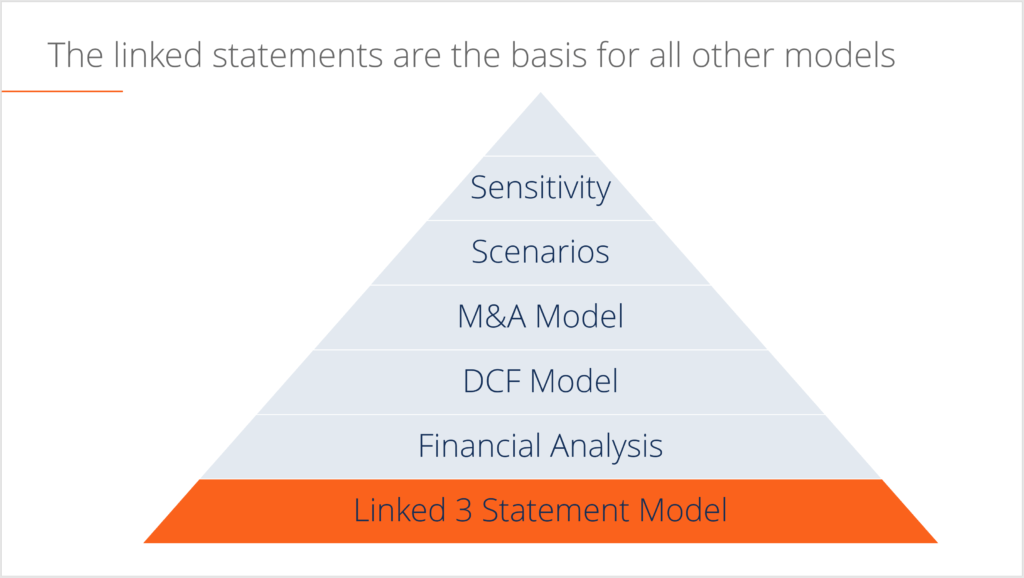
The three-statement model is also the foundation for more advanced financial models. Learn more through CFI’s Three-Statement Model Guide.
Discounted Cash Flow Model
A Discounted Cash Flow, or DCF model, is used to estimate the value of a company based on its expected future cash flows.
An analyst forecasts future free cash flows and discounts them back to their present value using an appropriate discount rate. DCF analysis is widely used in company valuation, investment banking and equity research.
You can learn more about this methodology through CFI’s DCF Valuation Guide.
M&A and LBO Models
M&A models are used to analyse mergers and acquisitions and understand how a transaction may affect the combined company. They can include purchase price, financing, debt, equity, synergies and earnings impact.
LBO models are commonly used in private equity to evaluate acquisitions involving significant debt financing. They help investors understand cash generation, debt repayment and potential investment returns.
Financial Modelling and Company Valuation
Financial modelling and valuation are closely connected. Before valuing a company, analysts need to understand its historical performance and develop reasonable forecasts for the future.
A typical process involves analysing historical financial statements, forecasting revenue and expenses, calculating free cash flow and applying a valuation methodology.
Common approaches include Discounted Cash Flow analysis, Comparable Company Analysis and Precedent Transactions. A strong financial model helps analysts understand how changes in business assumptions can affect the estimated value of a company.
Financial Modelling Career Opportunities
Financial modelling is relevant to several finance careers.
- Investment Banking – M&A, IPOs, fundraising and valuation
- Equity Research – forecasting company performance and estimating valuations
- FP&A – budgeting, forecasting, scenario planning and management reporting
- Corporate Finance – investment decisions, acquisitions and capital allocation
- Private Equity & Valuation – evaluating businesses, transactions and investment returns
If investment banking is your career goal, explore the Investment Banking Program at CFI Education.
How to Learn Financial Modelling?
The best way to learn financial modelling is to combine theoretical knowledge with practical projects. Start by understanding accounting and the three financial statements before developing your Excel skills.
Once you are comfortable with the fundamentals, build a simple three-statement model using historical company data. You can then progress to forecasting, DCF valuation, comparable company analysis and advanced models such as M&A and LBO models.
Practical experience is particularly important because it helps you understand how financial models are applied to different businesses and industries.
Who Should Learn Financial Modelling?
Financial modelling can be valuable for finance students, MBA graduates, commerce graduates and working professionals. It is particularly useful for people targeting investment banking, equity research, private equity, FP&A, corporate finance and valuation roles.
Entrepreneurs can also benefit from financial modelling because it helps them understand revenue forecasts, operating costs, cash requirements, profitability and business valuation.
Learn Financial Modelling With CFI Education
Developing financial modelling skills requires both financial knowledge and practical application. CFI Education’s Financial Modelling Course is designed to help learners develop practical skills in financial modelling, financial statement analysis, valuation and related areas of finance.
The program focuses on applying financial concepts to practical business situations, making it relevant for students and professionals preparing for careers in investment banking, equity research, corporate finance, FP&A and valuation.
Ready to build practical financial modelling skills? Explore CFI Education’s Financial Modelling & Valuation program.
Frequently Asked Questions
What is financial modelling?
Financial modelling is the process of creating a structured financial representation of a business using historical data, assumptions and forecasts. It is commonly used for financial planning, forecasting, valuation and investment analysis.
Is financial modelling difficult?
Financial modelling can be challenging initially because it combines accounting, finance, Excel and analytical thinking. Learning these areas step by step and practising with real-world examples can make it easier.
Is Excel necessary for financial modelling?
Excel is one of the most commonly used tools for financial modelling. Strong Excel skills are therefore highly useful, although understanding accounting and financial concepts is equally important.
What are the main types of financial models?
Common financial models include three-statement models, DCF models, M&A models, LBO models, budgeting models and forecasting models.
Is financial modelling useful for investment banking?
Yes. Investment banking professionals use financial modelling for valuation, mergers and acquisitions, IPO analysis, fundraising and transaction analysis.
Can freshers learn financial modelling?
Yes. Freshers can begin with accounting and Excel fundamentals and gradually learn financial statements, forecasting, valuation and practical financial modelling.
Conclusion
Financial modelling is more than creating spreadsheets. It is a practical finance skill that helps professionals understand businesses, forecast future performance, evaluate investments and support important financial decisions.
A strong financial modeller combines accounting knowledge, Excel skills, financial analysis, forecasting, valuation and business understanding. These skills can be useful across investment banking, equity research, private equity, FP&A, corporate finance and valuation.
If you are planning a career in finance, developing practical financial modelling skills can be an important step toward becoming a stronger and more effective finance professional.
BFinancial Modelling: Complete Guide to Skills, Models & Careers
03rd Nov 2026
BCFA vs Financial Modeling (FMVP) Course
10th Jun 2026

BBest Finance Certifications After BCom in 2026
30th May 2026

BTop Investment Banking Interview Questions And Answers
28th May 2026

BData Analytics Certification: How a Excel VBA Program Can Land Your Dream Job?
05th May 2026

BA Must-Have Skill for Your Finance Career in 2026: Financial Modelling With Excel
05th May 2026

B9 Best Financial Modelling and Investment Banking Books for you
29th Apr 2026

BData Analytics Jobs: 9 Career Options You Can Explore
28th Apr 2026

BTop 10 financial modeling firms in India
28th Apr 2026

BTop 7 Financial Modeling Tools You Should Master in 2026
12th Mar 2026

BTop High-Paying Finance Jobs You Should Consider in 2026
03rd Mar 2026

B2026 CFA Study Material, Exam Date, and Fee Guide
27th Jan 2026

BTop Finance Career Options In 2026
19th Dec 2025
BValuation vs. Pricing: The Key Difference
15th Dec 2025

B5 Data Aggregations You Can’t Live Without
16th Oct 2025