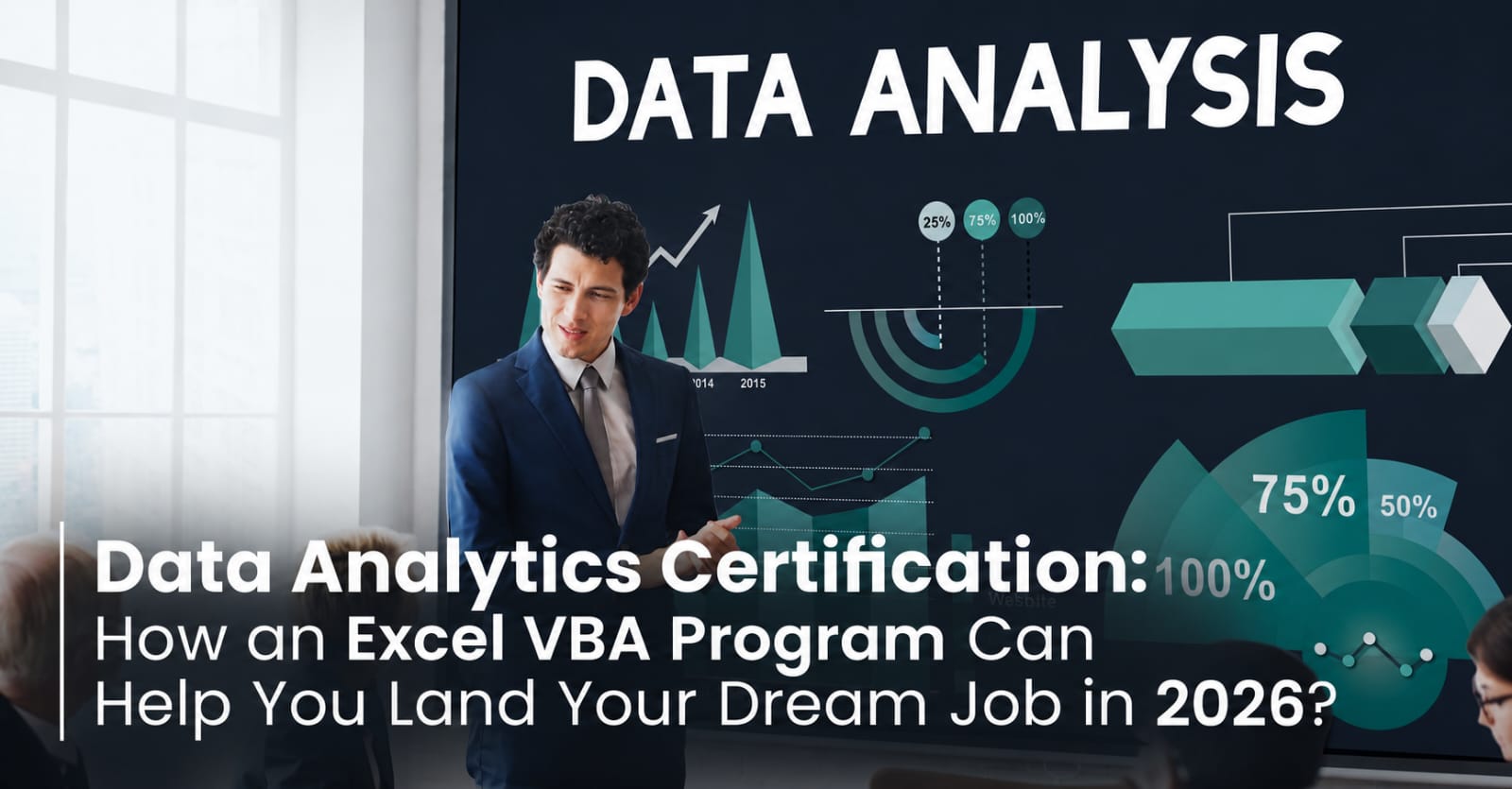
Data Analytics Certification: How a Excel VBA Program Can Land Your Dream Job?
Save up to 60% of your time when working with complex datasets through automation and efficient workflows.
The demand for skilled data professionals continues to grow rapidly, and with this demand comes increased competition.
To stand out in the evolving field of data analytics, you need more than just technical skills—you need a clear strategy to demonstrate and apply your expertise.
Companies are becoming more selective in hiring the right talent.
So, how do you position yourself effectively?
→ Data Analytics Certifications
Certifications can be valuable in strengthening your profile, but their real impact depends on how well you apply the skills in practical scenarios.
In this blog, you’ll uncover:
[ez-toc]
By the end of this guide, you’ll have a clear roadmap to kickstart or elevate your career in the ever-evolving world of data analytics.
Let’s dive in and explore how Excel VBA can unlock new opportunities for you!
What’s a Data Analytics Certification?
A Data Analytics Certification is a structured program designed to equip you with skills that help you:
- Dive deep into data
- Uncover meaningful insights
- Transform raw numbers into actionable strategies
Unlike a data analytics certificate (often a short-term training program), a certification typically involves an assessment or evaluation process to validate your knowledge.
It acts as proof of your capabilities and signals to employers that you have job-relevant analytical skills.
What will you learn from a Data Analytics Certification?
A data analytics certification helps you build in-demand skills, such as:
- Analyzing data to extract insights
- Processing data to solve real-world problems
- Using tools efficiently to streamline workflows
- Communicating insights through data visualization
- Organizing and presenting data in a structured manner
In 2026, many certifications also include automation, basic programming, and real-world case studies to align with industry expectations.
Why Get Certified?
Data analysts play a crucial role in cleaning, organizing, and visualizing data in ways that drive decisions and solve problems.
Certifications are tailored to help you gain this exact skill set, making you stand out to employers and opening the door to career growth.
When choosing a certification, consider whether:
- Hiring managers recognize and respect it.
- It teaches valuable, job-ready skills.
You can start with our Data Analytics Certification here.
Here’s what the curriculum looks like:
This will help you gain the expertise needed to land your dream job and excel as a data analyst.
What is the Excel VBA Program?
Microsoft Excel is widely used for working with structured data.
VBA (Visual Basic for Applications) is a programming language built into Microsoft tools like Excel, PowerPoint, and Outlook.
Its primary purpose is:
→ Automation
With VBA, you can:
- Automate repetitive and time-consuming data tasks
- Perform operations beyond standard formulas and functions
- Build more efficient and scalable workflows
Why Learn VBA?
While VBA may seem complex initially, it becomes easier with practice, especially for basic automation tasks.
It is particularly useful in environments where Excel-based workflows are still widely used.
In 2026, VBA remains relevant, especially in finance, operations, and legacy systems, although it is often complemented by tools like Python and Power BI.
How Does VBA Compare to Formulas and Functions?
VBA automates actions in Excel, such as:
- Generating reports
- Updating spreadsheets
- Handling repetitive processes
In contrast, formulas and functions focus on calculations and data logic.
Combining both allows you to build more efficient and scalable solutions.
How it can help you land your dream job?
In today’s competitive job market, recruiters highly value automation skills like VBA.
Here’s why mastering VBA can give you an edge:
1. Streamlines Workflows and Saves Time:
Recruiters prioritize candidates who can enhance efficiency.
VBA allows you to automate repetitive, time-consuming tasks which helps organizations save valuable time and resources.
→ This makes you an asset to any team.
2. Recognized and Verified Certifications:
A certification signals to employers that you have validated expertise.
These certifications are widely recognized and can distinguish you from other candidates, especially in industries like finance and data analytics.
3. Job Security:
In a world driven by automation, professionals who can optimize processes with tools like VBA are indispensable. When you know how to automate tasks, you make yourself harder to replace.
Mind you, it’s a critical factor in ensuring job stability.
4. VBA Paired with Domain Knowledge:
While VBA alone is valuable, pairing it with domain expertise, such as:
- Finance
- SQL
- Data analytics—makes you even more attractive to recruiters.
For instance, many banks and finance companies rely on legacy systems and look for candidates with skills to optimize or maintain these systems.
5. Create a Portfolio to Impress Recruiters:
Employers may ask for a practical demonstration of your VBA skills.
Stand out by building a portfolio project that showcases:
- Advanced data manipulation (e.g., dictionaries, collections, arrays)
- Interactive dashboards with charts and tables
- UserForms for streamlined input and automation
- Event-driven automation processes
Make it a “wow” project that highlights your versatility and problem-solving abilities.
Why VBA Matters for Your Career?
Mastering VBA demonstrates to recruiters that you can improve efficiency and work with automation in data-heavy environments.
Whether you’re optimizing financial models or automating repetitive data tasks, VBA can support your productivity and problem-solving ability.
Conclusion
While VBA may not be the only skill required to secure a role in data analytics or finance, it can strengthen your overall profile when combined with core analytical and technical skills.
Recruiters increasingly value candidates who can contribute to efficiency and process improvement.
With VBA, you’re not just learning a technical tool—you’re developing the ability to automate repetitive tasks and streamline workflows.
This can help organizations save time and resources while improving operational efficiency.
Even if a company does not heavily rely on VBA, having exposure to automation tools is an added advantage.
In many cases, VBA can help reduce manual effort and improve turnaround time for routine tasks.
Building this skill, along with tools like Excel, SQL, and data visualization platforms, can position you as a more adaptable and capable candidate.
If you’re planning to build a career in data analytics, take a look at our data analytics certification program for structured learning which can help you gain foundational skills and practical exposure.
BCFA vs Financial Modeling (FMVP) Course
10th Jun 2026

BBest Finance Certifications After BCom in 2026
30th May 2026

BTop Investment Banking Interview Questions And Answers
28th May 2026
BData Analytics Certification: How a Excel VBA Program Can Land Your Dream Job?
05th May 2026

BA Must-Have Skill for Your Finance Career in 2026: Financial Modelling With Excel
05th May 2026

B9 Best Financial Modelling and Investment Banking Books for you
29th Apr 2026

BData Analytics Jobs: 9 Career Options You Can Explore
28th Apr 2026

BTop 10 financial modeling firms in India
28th Apr 2026

BTop 7 Financial Modeling Tools You Should Master in 2026
12th Mar 2026

BTop High-Paying Finance Jobs You Should Consider in 2026
03rd Mar 2026

B2026 CFA Study Material, Exam Date, and Fee Guide
27th Jan 2026
BTop Finance Career Options In 2026
19th Dec 2025
BValuation vs. Pricing: The Key Difference
15th Dec 2025

B5 Data Aggregations You Can’t Live Without
16th Oct 2025

BUnleashing the Power of Scatter Plots: Trends, Correlations, Outliers & Clusters — One Stop Guide !!
06th Oct 2025