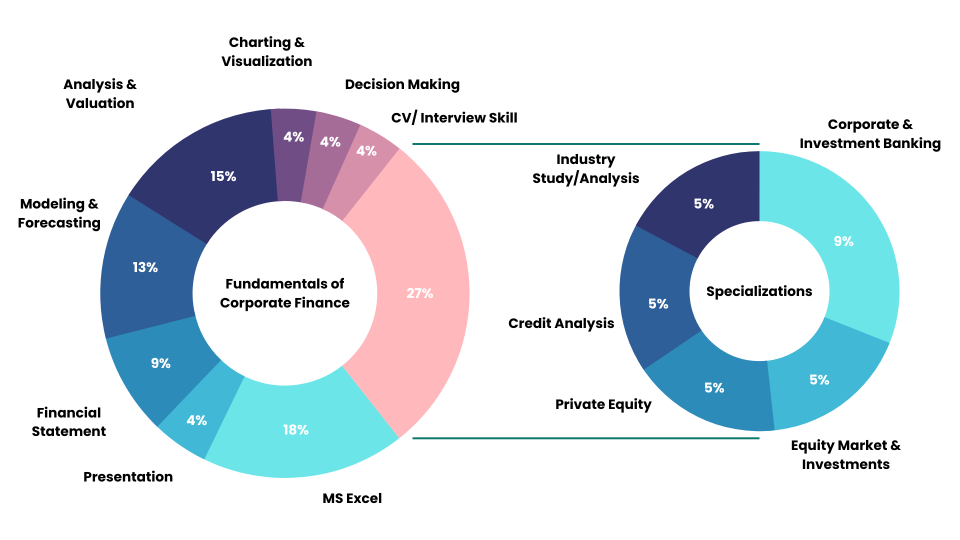
What skills will you develop in this course ?
Top Hiring Companies for this Program






















Who Should Enroll?
Our training is open to ambitious candidates who come from a range of backgrounds and will typically be

Graduates / Engineers

Post-Graduates / MBAs

CAs/CFAs or equivalents

Analysts / Executives

Business Decision Makers

CDBA Program Curriculum
- Using AI and ChatGPT in MS Excel New
- Keyboard Accelerators and Shortcuts
- Create and Customize the Excel List
- Data entry with Auto Fill Feature
- Working with Advance Cut, Copy, Paste Command
- Use of Find and Replace
- Using Paste Special
- Sorting and Filtering
- Advance Formatting
- Mathematical Functions
- Text Functions
- Statistical Functions
- Date & Time Functions
- Array Functions
- Database and Logical Functions
- Reference and Lookup Functions
- Financial Function
- What if Analysis (Goal Seek, Scenarios, Data Table)
- Pivot Table and Pivot Chart Reports
- Dashboard Creation and Visualization
- VBA Macro Basics
- Most used chart creation including Bar, Stacked, Line, Pie, Waterfall, Football Field etc
- PPT training for writing, formatting and alignment
- Best practices and shortcuts for pitch creation, overview slides, chart pasting
- Introduction to Financial Statements
- Understanding Income Statement, Balance Sheet and Cash Flow and Key Line Items
- Reading, Skipping and Skimming Annual Report
- Understanding Management Discussion & Analysis (MD&A)
- Ratio Analysis and Interpretation
- DuPont Analysis
- Types of Capital
- Basic Model – Case Study
- Modeling for 3 Financial Statements
- Revenue and Cost Modeling
- Building Supporting Schedule including Depreciation, Working Capital, Debt, Equity, Asset Schedules etc
- Building Scenarios (Base, Best, Worst Cases)
- Maintaining, Updating and Model Adjustments for Corporate Actions (CACS)
- Keeping the Model Dynamic
- Revenue Model Discussion for Various Industries
- Cost of Equity Modeling
- Cost of Debt Modeling
- WACC Calculation Best Practices
- Time Value of Money Basics
- Cash Flow Modeling (FCFF / FCFE) and Terminal Value Calculation
- Approaches to DCF Valuation
- Football Field Analysis and Discussion
- Introduction to Comparable Companies Analysis
- Select the Universe of Comparable Companies
- Locate the Necessary Financial Information
- Spread Key Statistics, Ratios, and Trading Multiples
- Determine Valuation using Comparable Companies
- Adjustment / Normalization of EBIT, EBITDA and Net Income
- Adjustments of Options, Warrants, RSUs and Convertibles for Dilution
- Concept of Calendarisation and Last Twelve Months
- CACS Discussions
- Interpreting Output Sheet
- Introduction to Precedent Transactions Analysis
- Select the Universe of Comparable Acquisitions
- Locate the Necessary Deal-Related and Financial Information
- Spread Key Statistics, Ratios, and Transaction Multiples
- Benchmark the Comparable Acquisitions
- Determine Valuation using Comparable Acquisitions
- Normalization of EBIT, EBITDA and Net Income
- Control Premium Calculation
- Difference between Trading & Transaction Comps
- Interpreting Output
- Introduction to Project Finance
- Sources and Uses of Funds
- IRR, Modified IRR, NPV, Profitability Index and Discounted Payback Period
- Project Finance – Case Study
- Real Estate Overview
- Understanding NOI, Cap rate, CoCR, Debt Amortization, among others
- Real Estate Modeling – Case Study
- Use of Financial Models in Pitchbook
- Flow of M&A / Restructuring Transaction
- Creation of Deep-dive Company Profile
- Discussion on live case
- Introduction to Industry Analysis
- Swot Analysis
- Competitive Benchmarking and Charts Creation
- Sector Index Creation
- Price Chart Creation and Rebasing
- Merger v/s Acquisitions
- Types of Mergers
- Motives behind M&A
- Synergies & Bootstrapping
- Accretion / Dilution Modeling
- Debt Capital Markets (DCM) Overview
- Types of Debt Raise
- Credit Analysis Matrix
- 5 Cs of Credit Analysis
- Debt Covenants
- Ability to pay analysis and Capitalization Table
- Discussion on live case
- ECM Overview, IPO & Global Markets
- Types of Investment Strategies (Active vs. Passive)
- Nifty Index, Asset Allocation & Mutual Funds
- Private Equity Overview
- Private Equity – Understanding & Modeling KPIs
- Introduction to LBO use cases
- LBO Overview and Terminologies
- Past Transactions
- Discussion on live LBO case
- Introduction to Power BI
- Power BI – Desktop Installation
- Power BI Fundmentals
- Dashboard Creation and Visualization – Case Study
- Do’s and Don’ts of Interviews Process
- CV Edits and LinkedIn Profile Building
How will the CIBRA program help candidates?
The CIBRA program helps you become a complete Investment Banking and Research Analyst and you will be able to perform:
- Investment Banking Research
- Equity Analysis and Research
- Financial Advisory
- Credit Analysis
- Project Finance Modeling
- Financial Analysis
Upcoming Batch Details

Investment Banking Program (CIBRA) - Certification
Students Speak

Manya Raheja
“Grateful, Grateful and just grateful to CFI institute for their support during my journey to clear CFA Level I. All the pride that I am carrying today is because of their support and special thanks to Akshay Sir for being a great mentor.”

Sandhya Sajwan
“Hi All, I am happy to share that I have cleared CFA Level-1.. and would like to thanks CFI institute, specially Akshay to help me to get there.! Thanks a lot and All the best to everyone whose going to appear next attempt.!”

Chems Arora
“CFI Education is a Good coaching institute for CFA Exam preparation. I passed two levels of the Cfa exam in consecutive attempts and giving level 3 in 2019. I will suggest joining CFI Education Institute if you want to prepare for the CFA Exam.”
Pankaj Gupta
“Great guidance and explanation of concepts that make it very easy to understand difficult topics. Have done CFA Level 2 and 3 coachings from CFI Education & cleared both levels in the first attempt. Highly recommended for CFA coaching.”
Amit Rajpal
“The examples/case studies used to explain the concepts was extremely relevant. Highly recommended to those looking for Financial Modelling, Investment Banking and CFA Prep Classes.”
Success Stories